Edge AI Adoption Roadmap: Optimize U.S. Data Processing by 25%

A 6-month Edge AI adoption roadmap for U.S. businesses can significantly optimize data processing by 25%, enabling faster insights and enhanced operational efficiency across various sectors through strategic implementation and technological integration.
In today’s hyper-connected business landscape, the ability to process data efficiently and in real-time is no longer a luxury but a fundamental necessity. This article delves into a pragmatic Edge AI Adoption Roadmap for U.S. businesses, meticulously crafted to optimize data processing by a remarkable 25% within just six months. We will explore how leveraging artificial intelligence at the network’s edge can revolutionize operations, offering unprecedented speed and insight.
Understanding Edge AI and Its Transformative Potential
Edge AI refers to the deployment of artificial intelligence algorithms directly on edge devices, rather than relying solely on centralized cloud servers. This paradigm shift brings computation closer to the data source, drastically reducing latency, conserving bandwidth, and enhancing data privacy. For U.S. businesses, the transformative potential of Edge AI lies in its capacity to unlock real-time decision-making and streamline complex operations.
By processing data where it’s generated, from manufacturing floors to retail environments, businesses can react instantaneously to critical events, optimize resource allocation, and deliver superior customer experiences. The implications extend across industries, promising a new era of agile and responsive enterprise.
Key Benefits of Edge AI for U.S. Enterprises
Adopting Edge AI offers a multitude of strategic advantages that directly contribute to the ambitious goal of a 25% data processing optimization. These benefits are not merely theoretical but are already being realized by pioneering companies.
- Reduced Latency: Real-time processing enables immediate responses, crucial for applications like autonomous vehicles and predictive maintenance.
- Lower Bandwidth Costs: Less data needs to be sent to the cloud, significantly cutting transmission expenses.
- Enhanced Security and Privacy: Data remains local, reducing exposure to cyber threats and simplifying compliance with regulations.
- Improved Reliability: Operations can continue even with intermittent or lost network connectivity.
Ultimately, understanding Edge AI is the first step toward harnessing its power. It is about decentralizing intelligence to create more resilient, efficient, and responsive business ecosystems, directly impacting the speed and quality of data insights.
Phase 1: Assessment and Strategy (Months 1-2)
The initial phase of any successful technological integration, particularly one as impactful as Edge AI, hinges on thorough assessment and strategic planning. This two-month period is crucial for U.S. businesses to lay a solid foundation, ensuring that subsequent efforts are aligned with overarching business objectives and yield measurable results in data optimization.
It involves a deep dive into current data processing workflows, identifying bottlenecks, and pinpointing areas where Edge AI can deliver the most significant impact. Without a clear understanding of existing infrastructure and desired outcomes, even the most advanced technology will struggle to find its footing.
Identifying Key Use Cases and Data Sources
The first step within this phase is to identify specific business problems that Edge AI can solve. This requires collaboration between IT, operations, and business unit leaders to prioritize initiatives based on potential ROI and feasibility.
- Operational Efficiency: Analyzing manufacturing lines for defects using computer vision at the edge.
- Customer Experience: Real-time personalization in retail stores based on in-store behavior analysis.
- Asset Management: Predictive maintenance for industrial equipment using sensor data processed locally.
- Supply Chain Optimization: Tracking and optimizing logistics in warehouses with edge analytics.
Simultaneously, businesses must map out their data sources. This includes identifying all relevant sensors, cameras, IoT devices, and other endpoints that generate data pertinent to the chosen use cases. Understanding the volume, velocity, and variety of this data is paramount for designing an effective Edge AI solution.
Infrastructure Audit and Gap Analysis
An exhaustive audit of existing IT infrastructure is essential. This involves evaluating current hardware capabilities, network architecture, and data storage solutions to determine their readiness for Edge AI deployment. A gap analysis will highlight areas requiring upgrades or new investments.
Key questions to address include: Do we have sufficient computational power at the edge? Is our network robust enough to handle data transfer to and from edge devices? What cybersecurity measures are in place to protect distributed AI models and data? This phase culminates in a comprehensive strategy document, outlining the chosen use cases, required infrastructure, and a clear roadmap for the subsequent phases, all geared towards achieving that 25% data processing optimization.
Phase 2: Pilot Program and Technology Selection (Months 3-4)
With a robust strategy in place, the third and fourth months are dedicated to transforming theoretical plans into practical reality through a controlled pilot program. This phase is critical for U.S. businesses to test the waters, validate initial hypotheses, and select the most suitable technologies before a broader rollout. It’s an iterative process of experimentation and refinement, ensuring that the chosen Edge AI solutions deliver on their promise of enhanced data processing.
The pilot program allows for real-world evaluation of performance, scalability, and integration with existing systems, minimizing risks associated with large-scale deployment.

Selecting Edge AI Hardware and Software
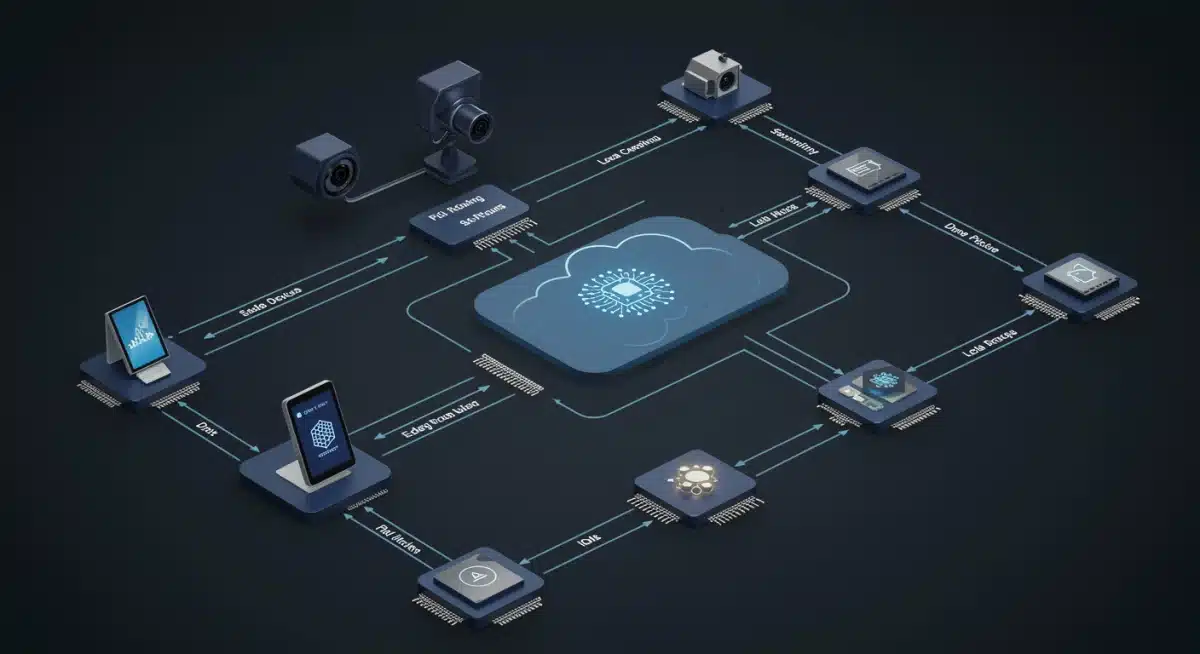
Choosing the right hardware and software is paramount for the success of the pilot. Edge AI devices range from powerful industrial PCs to compact, low-power embedded systems, each suited for different applications and environments. The selection process must consider factors such as processing power, energy consumption, ruggedness, and connectivity options.
Equally important is the software stack, which includes Edge AI frameworks, operating systems, and management platforms. Businesses need solutions that offer flexibility, ease of deployment, and robust security features. Partnerships with vendors specializing in Edge AI technologies can provide valuable expertise and access to cutting-edge solutions.
Developing and Deploying Initial Models
Once hardware and software are selected, the focus shifts to developing and deploying initial AI models for the chosen pilot use cases. This involves data preparation, model training (often in the cloud), and then optimizing these models for deployment on edge devices. Model compression techniques and efficient inference engines are crucial for maximizing performance on resource-constrained edge hardware.
The pilot deployment should be conducted in a representative environment, allowing for the collection of real-world performance metrics. This includes measuring latency reductions, accuracy improvements, and the overall impact on data processing efficiency. Feedback from the pilot is invaluable for iterating on model design, optimizing configurations, and preparing for the next phase of scaling.
This phase concludes with a clear understanding of which technologies and models perform best for the identified use cases, providing the confidence needed to proceed with broader implementation and further drive towards the 25% data processing optimization goal.
Phase 3: Integration and Scalability (Month 5)
Month five marks a pivotal shift from pilot validation to full-scale integration and planning for scalability. For U.S. businesses, this means taking the lessons learned from the pilot program and applying them to expand Edge AI capabilities across more devices and locations. The goal is to seamlessly integrate Edge AI solutions into existing operational workflows, ensuring they enhance, rather than disrupt, current processes.
This phase is about making Edge AI a natural extension of the business’s technological ecosystem, preparing for widespread adoption and realizing the full potential of data processing optimization.
Seamless Integration with Existing Systems
Integrating Edge AI solutions with legacy systems and cloud platforms is often one of the most complex aspects of deployment. It requires careful planning and execution to ensure data flows smoothly between edge devices, local servers, and centralized cloud infrastructure. APIs, middleware, and standardized data protocols play a crucial role in achieving this seamless connectivity.
Consideration must also be given to how Edge AI-generated insights will be consumed by existing business intelligence tools and operational dashboards. The objective is to provide a unified view of operations, where edge insights contribute to a holistic understanding of performance and drive informed decision-making.
- API Development: Creating robust APIs for data exchange between edge and cloud.
- Middleware Solutions: Utilizing platforms to bridge disparate systems.
- Standardized Protocols: Adopting MQTT, OPC UA, or other industry standards for IoT communication.
- Data Lake Integration: Ensuring edge data contributes to broader data analytics initiatives.
Planning for Future Expansion and Scalability
Scalability is not an afterthought; it must be a core consideration during the integration phase. Businesses need to design their Edge AI architecture with future growth in mind, anticipating increased data volumes, more edge devices, and the introduction of new AI models. This involves selecting scalable hardware, flexible software platforms, and a robust management framework capable of overseeing a distributed network of AI-enabled devices.
Developing clear deployment procedures, automated provisioning tools, and a centralized management console are essential for efficiently scaling Edge AI operations. This foresight ensures that the initial investments continue to deliver value as the business evolves and expands its reliance on real-time data processing.
By effectively integrating Edge AI and planning for scalability, businesses can solidify their path towards achieving and surpassing the 25% data processing optimization target, transforming their operational capabilities.
Phase 4: Deployment and Optimization (Month 6)
The sixth month marks the culmination of the Edge AI adoption roadmap: full-scale deployment and continuous optimization. For U.S. businesses, this phase is about rolling out the validated Edge AI solutions across the wider operational landscape and establishing mechanisms for ongoing performance monitoring and improvement. It’s where the investment in planning, piloting, and integration truly begins to pay off, delivering on the promise of significantly optimized data processing.
Successful deployment is not an endpoint but the beginning of a continuous journey of refinement, ensuring that Edge AI solutions remain effective and aligned with evolving business needs.
Full-Scale Rollout and User Training
The full-scale rollout involves deploying Edge AI hardware and software across all relevant locations and devices identified in the strategic planning phase. This requires meticulous coordination, efficient logistics, and adherence to established deployment protocols. It’s crucial to minimize disruption to ongoing operations while integrating new technologies.
Alongside the technical deployment, comprehensive user training is paramount. Operational staff, maintenance teams, and data analysts need to understand how to interact with the new Edge AI systems, interpret their outputs, and leverage the real-time insights they provide. Effective training ensures user adoption and maximizes the value derived from the new capabilities.
Monitoring, Maintenance, and Continuous Improvement
Post-deployment, continuous monitoring is essential to track the performance of Edge AI solutions, identify any anomalies, and ensure they consistently meet the targeted data processing optimization. This involves setting up dashboards to visualize key metrics, such as latency, model accuracy, and resource utilization.
- Performance Dashboards: Real-time visualization of Edge AI system health and data processing metrics.
- Predictive Maintenance: Implementing tools to anticipate hardware failures at the edge.
- Model Retraining: Regularly updating AI models with new data to maintain accuracy and relevance.
- Feedback Loops: Establishing channels for operational teams to provide feedback for system enhancements.
Regular maintenance, including software updates and hardware checks, is also critical for the long-term reliability of Edge AI infrastructure. Furthermore, a commitment to continuous improvement, driven by performance data and user feedback, ensures that the Edge AI solutions evolve, delivering sustained value and further pushing the boundaries of data processing efficiency.
Measuring Impact and Achieving 25% Optimization
The ultimate goal of this 6-month roadmap is to achieve a tangible 25% optimization in data processing for U.S. businesses. This phase focuses on rigorously measuring the impact of Edge AI adoption and validating that the strategic objectives have been met. It requires a clear methodology for quantifying improvements and demonstrating the return on investment.
Without precise measurement, the success of any technological initiative remains speculative. This final stage is about proving the value and setting the stage for future advancements.
Key Performance Indicators (KPIs) for Data Processing
To accurately measure the 25% optimization, businesses must establish clear and measurable KPIs from the outset. These KPIs should directly reflect the speed, efficiency, and quality of data processing before and after Edge AI implementation. Examples include:
- Data Ingestion Latency: Time taken from data generation to actionable insight.
- Processing Throughput: Volume of data processed per unit of time.
- Bandwidth Usage: Reduction in data transmitted to the cloud.
- Operational Downtime: Decrease due to predictive maintenance enabled by edge insights.
- Decision-Making Speed: Faster response times to critical events.
By tracking these metrics consistently, businesses can quantify the improvements brought about by Edge AI and demonstrate the direct correlation between the new technology and enhanced operational efficiency.
Calculating ROI and Future Scaling
Beyond technical metrics, it is crucial to translate the operational improvements into financial terms to calculate the return on investment (ROI). This involves quantifying cost savings from reduced bandwidth, improved energy efficiency, minimized downtime, and increased productivity. A positive ROI provides a strong business case for continued investment in Edge AI.
Achieving the 25% optimization is not merely a target but a benchmark for future scaling. With proven success, businesses can then explore expanding Edge AI to new use cases, integrating more advanced AI models, and further decentralizing their data processing capabilities. This continuous cycle of adoption, measurement, and scaling ensures that Edge AI remains a dynamic force for innovation and competitive advantage.
Measuring the impact is the final validation of the roadmap’s success, confirming that Edge AI adoption has indeed transformed data processing and positioned the business for sustained growth and efficiency.
Overcoming Challenges in Edge AI Adoption
While the benefits of Edge AI are compelling, U.S. businesses must be prepared to navigate a series of challenges during its adoption. These hurdles can range from technical complexities to organizational resistance, and proactively addressing them is key to a smooth and successful implementation. Recognizing potential obstacles allows for strategic planning to mitigate their impact and ensure the roadmap stays on track toward optimizing data processing by 25%.
A realistic understanding of these challenges fosters resilience and enables businesses to develop robust solutions.
Technical and Security Considerations
One of the primary challenges lies in the technical intricacies of deploying and managing AI at the edge. Edge devices often have limited computational resources, requiring highly optimized AI models and efficient inference engines. Ensuring compatibility between diverse hardware and software components can also be complex. Furthermore, the distributed nature of Edge AI introduces new cybersecurity vulnerabilities.
- Resource Constraints: Optimizing AI models for low-power edge devices.
- Interoperability Issues: Ensuring seamless communication between various devices and platforms.
- Data Security at the Edge: Protecting sensitive data on distributed devices from cyber threats.
- Remote Management: Efficiently updating, monitoring, and troubleshooting edge devices at scale.
Robust security protocols, including encryption, secure boot, and regular vulnerability assessments, are essential to protect edge deployments. Additionally, a centralized management platform is crucial for efficiently overseeing and updating a large fleet of edge devices.
Talent Gaps and Organizational Readiness
Another significant challenge is the scarcity of skilled professionals proficient in Edge AI development and deployment. Businesses need data scientists who can optimize models for edge environments, as well as engineers capable of integrating AI into diverse hardware platforms. Addressing this talent gap may involve upskilling existing employees, hiring new experts, or partnering with specialized vendors.
Organizational readiness also plays a vital role. Adopting Edge AI often requires a cultural shift towards data-driven decision-making and a willingness to embrace new operational paradigms. Clear communication, change management strategies, and leadership buy-in are essential to foster an environment conducive to successful Edge AI integration.
By anticipating and strategically addressing these technical, security, and organizational challenges, U.S. businesses can build a more resilient and effective Edge AI implementation, paving the way for sustained innovation and reaching their data processing optimization goals.
| Key Phase | Description & Goal |
|---|---|
| Months 1-2: Assessment | Identify use cases, audit infrastructure, and define strategy for Edge AI adoption. |
| Months 3-4: Pilot Program | Test Edge AI hardware/software, deploy initial models, and validate performance. |
| Month 5: Integration | Integrate Edge AI with existing systems and plan for scalable expansion. |
| Month 6: Deployment | Full-scale rollout, user training, and continuous monitoring for optimization. |
Frequently Asked Questions About Edge AI Adoption
The primary benefit is significantly reduced latency, as data is processed closer to its source. This enables real-time decision-making, which is crucial for applications demanding immediate responses, leading to faster insights and operational efficiency across various business functions.
By processing data locally, Edge AI minimizes the need to send large volumes of data to central cloud servers. This reduces network bandwidth consumption, lowers data transmission costs, and accelerates the entire data analysis pipeline, directly contributing to substantial processing optimization.
Key challenges include managing diverse edge hardware with limited resources, ensuring robust cybersecurity for distributed systems, and addressing the talent gap in specialized Edge AI development and deployment skills. Organizational readiness and integration with legacy systems are also critical hurdles.
Industries requiring real-time insights and low-latency operations benefit significantly. This includes manufacturing for predictive maintenance, retail for personalized customer experiences, healthcare for remote patient monitoring, and logistics for supply chain optimization. Any sector with extensive IoT deployments stands to gain.
A comprehensive roadmap, as outlined, suggests a 6-month timeline from initial assessment to full deployment and optimization. This period allows for strategic planning, pilot testing, integration, and continuous monitoring, enabling businesses to achieve noticeable improvements in data processing efficiency within this timeframe.
Conclusion
The journey to adopting Edge AI presents a compelling opportunity for U.S. businesses to fundamentally transform their data processing capabilities. By following a structured 6-month roadmap, from meticulous assessment and strategic planning to pilot programs, integration, and full-scale deployment, organizations can realistically target and achieve a 25% optimization in data processing. This not only translates into enhanced operational efficiency and reduced costs but also empowers real-time decision-making, fostering a more agile and competitive enterprise. Overcoming inherent challenges through proactive planning and continuous optimization will be crucial, ensuring that the promise of Edge AI is fully realized, driving innovation and sustainable growth in an increasingly data-intensive world.